
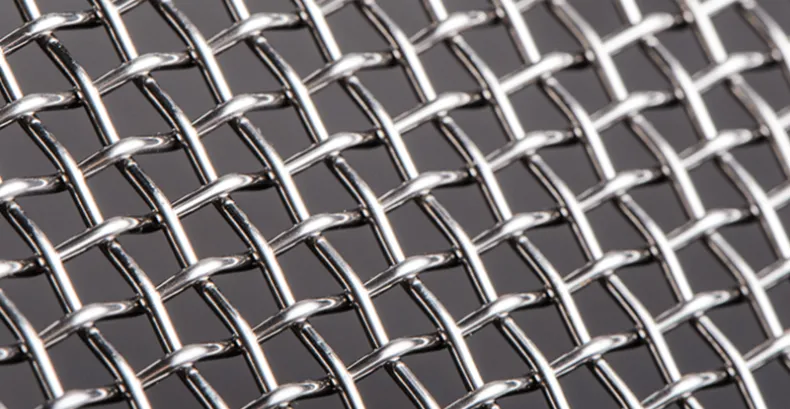

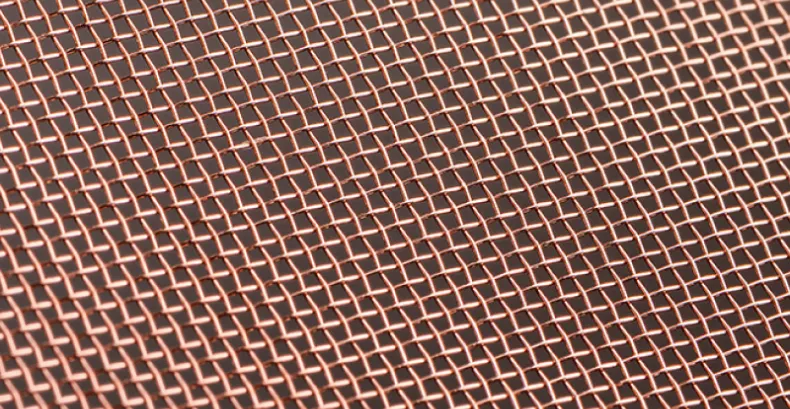





Wire-Mesh.pl supplies industrial sorting sieve screens made from AISI 304, 316, 316L and 321 stainless steel. Square-aperture woven wire screens may be supplied in accordance with the technical requirements of ISO 9044. Weave type, wire diameter and aperture tolerance decide how a screen actually performs, whether that's dry classification of bulk minerals or wet grading in a corrosive slurry. Below are the parameters that determine how long a screen mesh stays in service before it needs replacing.
High-efficiency industrial sorting sieve screens for heavy duty industries
A screen failure mid-shift costs more than the price gap between materials. That's why choosing industrial sorting sieve screens starts with operating conditions, not price: vibration frequency of the separator, moisture content of the feed, abrasiveness of the product being classified. Calling something "stainless steel" without specifying the grade tells a maintenance engineer nothing useful.
AISI 304 provides standard corrosion resistance and works well with dry, chemically neutral materials. AISI 316 and its 316L variant provide higher corrosion resistance in many wet and chemical environments. The lower carbon content of 316L reduces the risk of intergranular corrosion after welding. AISI 321, stabilized with titanium, is intended primarily for applications involving prolonged exposure to elevated temperatures. Its suitability for abrasive materials depends on the actual operating conditions.
|
Steel grade |
Application |
Key property |
|---|---|---|
|
AISI 304 |
Dry screening, neutral materials |
Standard corrosion resistance |
|
AISI 316 |
Wet grading, selected chemical environments |
Improved corrosion resistance |
|
AISI 316L |
Welded edges, frame structures |
Low carbon content |
|
AISI 321 |
High temperature, abrasion |
Titanium stabilization |
Heavy-duty screening mesh for separators and vibratory machinery
A modern vibratory separator operates at hundreds or thousands of vibration cycles per minute, depending on its design. Under that kind of dynamic load, wire without sufficient fatigue resistance may break at the weave’s flex points before reaching its expected service life. Screening mesh for separators available from Wire-Mesh.pl is selected according to the separator design and operating conditions.
Key technical parameters include wire diameter tolerance and aperture accuracy. ISO 9044 applies to industrial woven wire screens with square apertures, while ISO 4783 defines recommended combinations of aperture size and wire diameter, together with dimensional designation principles. A deviation in aperture size can affect the final product’s particle-size distribution and the performance of the sorting wire mesh screen.
Reliable stainless steel separation mesh for wet grading processes
Wet grading is a different operating regime altogether from dry classification: the water slurry accelerates corrosion and encourages fine particles to clog the aperture. Stainless steel separation mesh in AISI 316 may provide better corrosion resistance than AISI 304, provided it is suitable for the composition, concentration and temperature of the working medium.
Stainless steel sifting wire in this grade also offers improved resistance to pitting in many chloride-containing environments, although suitability depends on chloride concentration and temperature. Weave type has a direct impact on how a screening surface performs on the plant floor. Square openings provide uniform material flow and a predictable separation curve, making them the standard choice for aggregate and sand classification. Rectangular or slotted openings can increase throughput when handling elongated particles and help reduce the risk of pegging, although they may affect classification accuracy. Plain weave performs well in many screening applications, while the selection of twilled or other weave types should be based on the required aperture size, wire diameter, and expected mechanical loading.
Weave geometry also affects resistance to blinding — wet, fine-grained material clogging the openings, which can significantly reduce screen output. A correctly sized separator screen mesh with the right wire diameter can limit this effect and reduce the need for additional cleaning systems.

Advanced technical mesh for separation of bulk materials
Screening construction aggregates runs on different priorities than classifying ore or seed: throughput and abrasion resistance come first, which is why you see heavier wire gauges and reinforced mounting frames here. Technical mesh for separation is selected according to the hardness of the material, its particle size, shape and moisture content.
The typical dry grading case is calibrating construction sand: material passes over the screen without water, and separation relies on gravity, mechanical vibration and material movement across the screening surface. This application calls for a square-opening mesh optimized for high throughput without losing separation accuracy — a category that also covers general sorting and sifting screens used across mineral processing lines.
Durable wire mesh for sorting machines with maximum calibration accuracy
Calibration accuracy means something different in agriculture and seed processing, where aperture tolerance gets measured in tenths of a millimeter. Vibrating screen mesh for sorters running in this segment has to hold its dimensional stability through frequent cleaning cycles and constant exposure to organic dust.
For that application, Wire-Mesh.pl supplies wire mesh with controlled aperture geometry and consistent aperture dimensions from batch to batch — parameters that help maintain stable seed classification.
Performance metrics of premium metal filtration and sorting mesh from Wire-Mesh.pl
As a supplier of mesh for mechanical separation, Wire-Mesh.pl helps select screens according to the customer’s actual operating conditions rather than a generic specification. Metal filtration and sorting mesh is used in ore processing plants, cement works, food and agricultural processing facilities and chemical installations — each segment with different abrasion and corrosion exposure.
The parameters that actually determine screen lifespan:
- Steel grade matched to the working medium (304, 316, 316L, 321) and its resistance to that specific environment.
- Aperture size and wire diameter tolerance, verified against the standard applicable to the specific mesh type.
- Mesh tension in the frame — a loose mount increases deflection and accelerates wire fatigue at high vibration frequencies.
- Weave type in woven wire mesh particle-separation systems, matched to feed moisture and particle shape.
Instead of screens sold as used equipment on classified listing sites, Wire-Mesh.pl supplies exclusively brand-new mesh, whose correct selection can extend service intervals and reduce unplanned downtime. Every wire screen cloth for vibratory sorters is selected using the actual installation parameters rather than an averaged catalogue specification. This approach can improve operating stability in both heavy-duty separator lines and smaller particle-separation systems.


