
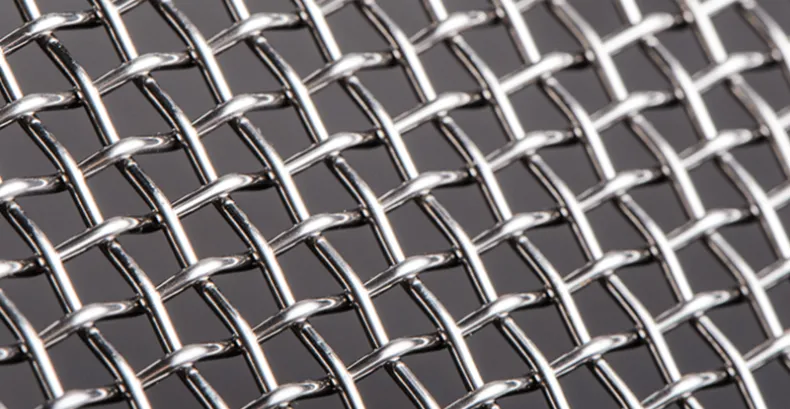

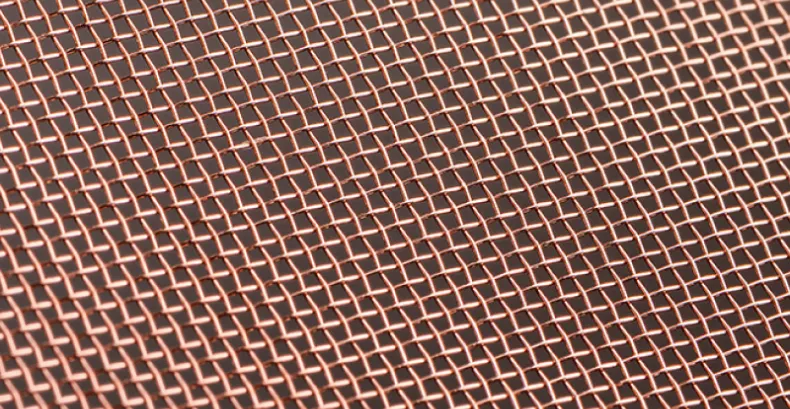





Heavy-Duty mesh for vibrating screeners and sorting systems by Wire-Mesh.pl
The durability of a screening surface is determined not by a declared number of cycles, but by wire properties, aperture geometry, tensioning, and the actual feed load. Spring steel formerly specified under DIN 17223 and now under EN 10270-1 can provide high tensile strength and good resistance to cyclic loading, but the standard itself does not define the service life of the finished screen. A precision sand screening mesh helps maintain a stable separation point, reduce the amount of off-spec material, and minimize the number of recirculation passes through the installation.
We manufacture mesh for vibrating screeners from wire selected according to mechanical load, required open area, and environmental conditions. Instead of promising unchanged geometry after a specified service period, we control wire diameter, aperture size, weave type, and the fixing method. As a manufacturer of metal screening surfaces, we also produce custom designs adapted to frame dimensions and tensioning systems. Every screening mesh should be selected on the basis of machine data and feed characteristics rather than on the expected operating time alone.
The category of mesh for vibrating screeners includes surfaces manufactured according to agreed technical documentation. Direct production shortens the supply chain, although lead time still depends on material availability, dimensions, edge fittings, and the current production workload. CAD designs for non-standard frames should be approved before manufacturing begins in order to reduce the risk of installation errors.
Deliveries are carried out throughout Poland, including Silesia, Lower Silesia, and Mazovia, as well as to other European Union countries. In intra-EU trade, there is no customs clearance typical of imports from outside the EU. Delivery times are nevertheless influenced by transport, material availability, and shipment dimensions. Maintaining consistent dimensional documentation makes it easier to repeat orders and verify the conformity of subsequent batches.
The production range includes:
- square apertures from 0.5 to 150 mm,
- wire diameters from 0.8 to 12 mm,
- C-, V-, and U-type side fittings selected for the mounting system,
- versions adapted to Powerscreen, Keestrack, Sandvik, Metso, Terex Finlay, and McCloskey screening machines.
Vibrating screen deck mesh is selected according to the machine model, deck dimensions, vibration amplitude and frequency, deck inclination, feed type, and required capacity. Frame dimensions alone are not sufficient.
Industrial sand screening mesh and gravel sorting - technical specifications
Wear rate depends not only on particle sharpness. Mineralogy, hardness, the proportion of oversize material, moisture content, drop height, and feed velocity are also important. A stainless-steel sand screening mesh made from AISI 304 / EN 1.4301 may be suitable for wet feed and moderately corrosive environments. Under high impact or abrasive loads, spring wire is often used, but the choice between spring steel and stainless steel should result from an analysis of the combined effects of wear and corrosion.
In installations with variable feed conditions, a sand screening mesh should provide a balance between wire durability, open area, and separation accuracy. A screen made with thicker wire may be mechanically more durable, but with the same aperture it will have a smaller open area.
AISI 316 / EN 1.4401 stainless steel offers higher corrosion resistance than AISI 304 in many chloride-containing environments. However, this does not mean complete resistance to seawater or all process chemicals. In saline environments, chloride concentration, temperature, wetting time, and the possibility of crevice formation must all be considered. The economic justification for a higher-grade material depends on comparing service life, replacement cost, and production losses rather than assuming a fixed payback after one season. These factors should also be taken into account when selecting a sand and gravel sieve for demanding operating conditions.
Apertures that are too small or an unsuitable weave increase the risk of blinding and particle pegging, while apertures that are too large allow material outside the target fraction to pass through, reducing the separation efficiency of a sand and gravel sieve.
PN-EN 933-1 describes the reference method for determining the particle-size distribution of aggregates by sieving. It is not, however, a design standard for industrial screening surfaces. In a multi-deck installation, final aggregate classification may be performed on a separate control deck.
How to choose the optimal sand and gravel sieve for quarry operations?
Quarries operating continuously require a screening surface adapted to changing moisture conditions and loading. A sand and gravel sieve with a double-crimp weave can provide greater wire stability when the relationship between aperture size and wire diameter is properly selected, although it is not automatically more durable than a single-crimp design in every application.
When selecting a screening surface, we analyze capacity in tonnes per hour, the proportion of oversize material, the feeding method, open area, and surface tension. Drop height, material distribution across the deck, and the location of support points are also important.
Professional technical wire mesh for sand screening with high fractioning precision
Technical wire mesh for sand screening is selected according to nominal aperture size and permissible tolerances rather than according to a single universal tolerance. The required precision depends on the aperture range and the product specification. A 0.05 mm deviation in wire diameter does not automatically distort the entire particle-size distribution, but it can change the open area and the actual weave geometry.
A sand sifter screen with square apertures provides the same nominal dimension in two perpendicular directions. This does not eliminate the passage of flat or elongated particles, because their orientation during movement affects the probability of passing through the aperture. Screening precision is evaluated on the basis of process results, not solely on the diagonal of the opening.
Durable soil sifter wire screen for landscaping and construction
Topsoil, black soil, and reclamation material contain stones, roots, clods, and wet fine fractions. A soil sifter wire screen must therefore combine impact resistance with a reduced tendency for aperture blinding.
This does not always mean using the wire with the highest yield strength. An excessively rigid surface may respond poorly to local overloads, so wire ductility, weave type, and the support arrangement are also selected carefully.
In road construction, similar requirements apply to the screening of soils, bedding materials, and recycled materials. The safety margin should result from operational data and process characteristics rather than from a simple division into “strong” and “weak” constructions.
A second set of challenges appears in composting plants. A soil sifter wire screen used with organic material operates under elevated humidity and in contact with substances generated during decomposition. Under such conditions, both corrosion and surface blinding must be controlled.
Optimal topsoil sifting mesh for organic contaminant removal
A topsoil sifting mesh used to separate roots, stones, and organic residues should be adapted to the machine design and the required product quality. It cannot be assumed that it always operates at a lower frequency than an aggregate screen. Motion parameters depend on the type of screener, the feed, and the required capacity.
The goal is to loosen the material without excessively breaking down its components. A similar principle is used in agriculture, where seed-grading meshes separate material by size while minimizing mechanical damage.
The mesh alone cannot guarantee the full integrity of every batch. Feed height, transport speed, the number of passes through the machine, and the design of the entire processing line are equally important.
Flexible sand sifter screen on rotary trommels
Rotary trommels load the screening surface differently from flat vibrating screens. Material is lifted and dropped during drum rotation, causing abrasion, impacts, and cyclic loading of the fastening points.
A sand sifter screen for this application should be formed to match the drum radius and properly supported. It does not need to be excessively flexible, but it must not crack during forming or operation. In composting plants, constant moisture, material adhesion, and accessibility for cleaning must also be considered.

Industrial sand and gravel riddle screen and perforated metal screens for extreme loads
Perforated metal screens provide rigid aperture geometry and can perform well under heavy, impact-loaded feed conditions. However, they are not a universal solution to blinding: wet and clay-rich materials can block both perforated holes and woven apertures.
Selection depends on hole shape, spacing, plate thickness, open area, and material movement. Woven screens usually provide a larger open area for a comparable aperture size, but they may be more susceptible to the pegging of borderline particles.
In addition to woven and perforated solutions, harp screens and string screens are also used. Their independently moving wires can reduce particle pegging when processing difficult materials. They do not, however, provide both maximum open area and maximum rigidity at the same time; these parameters remain a design compromise.
|
Parameter |
Woven mesh |
Perforated metal screens |
|---|---|---|
|
Typical manufacturing range |
Depends on weave type and wire diameter |
Depends on plate thickness and perforation technology |
|
Blinding risk |
Depends on aperture size, weave, and moisture |
Depends on hole shape, profile, and feed type |
|
Abrasion resistance |
Depends on steel grade and wire diameter |
Depends on material, plate thickness, and hole edges |
|
Typical application |
Sand, gravel, and fine-to-medium aggregates |
Heavy feed, primary screening, impact loads |
High-durability perforated screen plates for coarse grading
Perforated screen plates used in coarse grading must maintain aperture geometry under heavy cyclic loading. The number of load cycles per hour depends on the frequency of the specific screening machine, and not every node has to be made as a lock-crimp weave. The crimp type is selected according to aperture size, wire diameter, and surface loading.
The term “wire sieve crossword” is not a standardized industrial design name. When placing an order, the actual screening surface should be specified — single-crimp, double-crimp, lock-crimp, harp, string, or perforated screen plates — together with the required aperture size and mounting system. This allows the surface to be defined correctly without attributing non-existent support points or claiming a guaranteed doubling of service life.
A second sand and gravel riddle screen intended for the same machine may require a different wire or weave if the product fraction or feed characteristics change. Frame dimensions, typical moisture content, the proportion of oversize material, capacity, and the mounting system should be specified when ordering.
Side fittings transfer the surface tension to the frame, but they do not carry all stresses by themselves. The load is distributed among the wires, edges, fittings, and support elements.
Why choose industrial sand screening cloth from a European manufacturer?
Industrial sand screening cloth for construction sand and fine aggregates should be resistant to transport, frequent handling, and localized material impacts.
It does not have to be made from the same wire as a surface used in a heavy industrial screener. Steel grade, wire diameter, and aperture size should be matched to the actual operating loads in order to avoid unnecessary weight and cost.
Direct cooperation with a European manufacturer makes it easier to agree on dimensions, fittings, and the intended application before production begins. The main advantage is the possibility of manufacturing the screen according to machine documentation and resolving technical issues efficiently, rather than relying solely on a “premium version” declaration.
A properly selected vibrating screen deck mesh can also simplify future replacement planning and improve the repeatability of screening performance across subsequent production batches.


