






High-performance industrial metal mesh solutions for challenging sectors
AISI 316L typically contains around 2–3% molybdenum, which improves resistance to pitting and crevice corrosion in many chloride-containing environments and against certain acids. It does not eliminate corrosion risk. Grade selection still requires data on media concentration, temperature, pH, wetting time and cleaning conditions.
We design industrial wire mesh for a specific screen, filter or sorting unit, taking into account aperture dimensions, wire diameter, weave pattern, mechanical loading and the process environment. Different sectors require different material properties. In food processing, corrosion resistance, cleanability and compliance with hygiene requirements are central; in aggregate processing, abrasion, impact loading and aperture stability may be more important.
Plants using industrial vibrating screens with controlled aperture geometry can reduce the risk of producing an off-specification fraction. Dimensional documentation alone does not guarantee final product quality, because machine settings, feed distribution and material characteristics also affect sorting and screening performance.
Leading industrial wire mesh manufacturer – precision and advanced technology
As an industrial wire mesh manufacturer, Wire-Mesh.pl produces components from customer drawings, agreed specifications or application-specific engineering documentation. In-house manufacturing allows the aperture, wire diameter, weave, panel dimensions and edge treatment to be selected for the process instead of restricting the design to standard stock formats.
A responsible industrial wire cloth supplier should also define the inspection scope and the documents required for acceptance. EN ISO 9001:2015 concerns an organisation’s quality management system, not the tolerances of an individual mesh. ISO 4783 specifies preferred combinations of aperture size and wire diameter for industrial screens and woven wire cloth, but it does not define every permissible manufacturing deviation.
For woven square-aperture meshes, ISO 9044 specifies requirements and inspection methods. ISO 14315 may apply to industrial wire screens. The required material documentation should be agreed at the order stage.
An EN 10204 type 3.1 inspection certificate contains material test results linked to the supplied batch. It is not automatically included with every product and does not, by itself, certify the performance of the finished screen. Full traceability requires the material certificate to be linked to the wire batch and production records.
Key categories: From heavy duty industrial screens to fine filters
The product range covers heavy duty industrial screens as well as fine filtration surfaces. Several technologies may be selected for different loads and process duties:
- single-crimp, double-crimp and lock-crimp screens for larger apertures and dynamic loading;
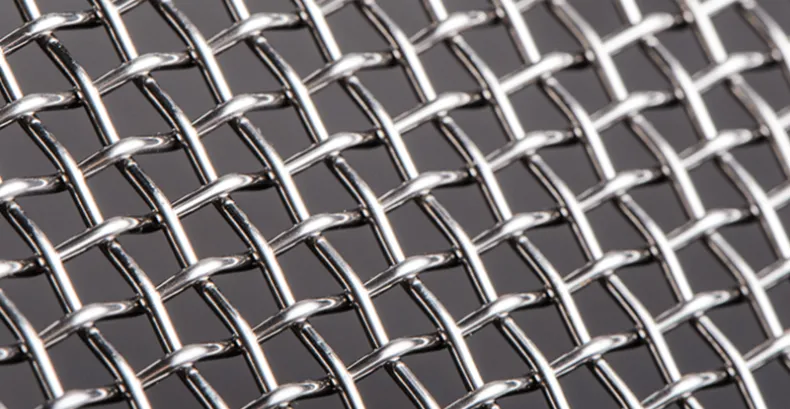
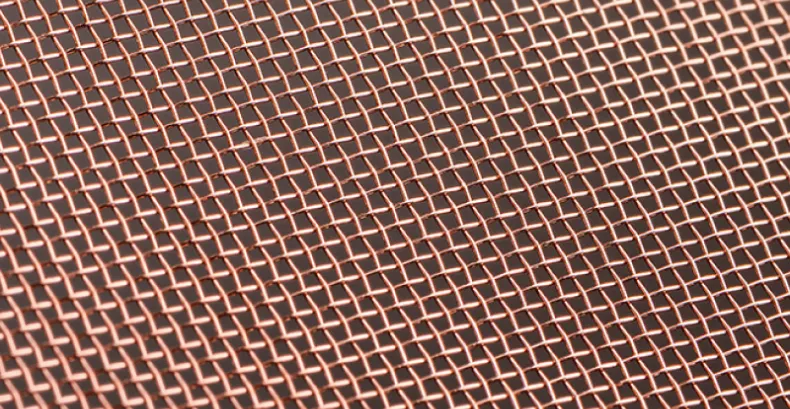
- plain and twill weaves for accurate classification and industrial filtration;
- woven square-aperture meshes for separating bulk materials;
- welded meshes for structures requiring high rigidity and stable joints.
Every wire mesh cloth specification requires confirmation that the selected material is available in the required diameter and weave. Not every configuration can be produced in uncoated carbon steel, galvanized steel, AISI 304, AISI 316L or AISI 321. Manufacturing feasibility depends on weaving or welding technology, wire properties and the required aperture dimensions.
An industrial metal mesh manufacturer should define mounting tension according to the screen design and panel requirements. Insufficient tension can allow the surface to strike its supports and accelerate wire fatigue; excessive tension can overload the wires, hooks and frame. Creep is not a typical failure mechanism for steel mesh operating at ambient temperature.
Long-term durability – why choose stainless steel industrial mesh
Acid-resistant AISI 316L wire usually provides better pitting resistance than AISI 304 because of its molybdenum content, but it does not prevent pitting completely. In warm solutions with high chloride concentrations, 316L may still suffer pitting, crevice corrosion or stress corrosion cracking.
Stainless steel industrial mesh should therefore be selected according to the specific medium, temperature, contact time and cleaning method. AISI 321 is a titanium-stabilised austenitic stainless steel valued for its resistance to intergranular corrosion after exposure to elevated temperatures. For prolonged thermal loading, high-temperature grades such as 321H or purpose-designed heat-resistant alloys may be more suitable.
Correctly selected stainless steel can extend service life, but it does not remove the need for inspection, cleaning and periodic replacement.
|
Parameter |
AISI 304 |
AISI 316 / 316L |
|---|---|---|
|
Resistance to chlorides |
Good in mild conditions; limited at higher concentration and temperature |
Usually higher than AISI 304, but not absolute |
|
Typical applications |
Food processing, process equipment and atmospheric environments |
Chemical processes, wet environments and applications with increased corrosion risk |
|
Molybdenum content |
Usually no intentional addition |
Typically around 2–3% |
|
Relative cost |
Usually lower |
Usually higher and dependent on alloy market conditions |

Custom solutions – bespoke metal mesh production and technical customization
An older or modified machine often requires a component manufactured to its actual dimensions because original documentation may be incomplete. Bespoke metal mesh production can be based on DXF, DWG or PDF files, measurements of an existing component and details of the mounting system.
The drawing should specify more than the external outline. It should also define weave direction, aperture size and shape, wire diameter, tolerances, edge treatment and required material. Custom industrial wire mesh can only be produced accurately when these inputs are reliable.
Industrial filtration may require a non-standard aperture-to-wire ratio. A metal filter mesh with the correct weave can operate with nominal apertures below 100 µm, but actual particle retention also depends on particle shape and size distribution, fluid viscosity, pressure differential and filter-cake formation. Nominal aperture size is not automatically an absolute filtration cut-off.
A pre-production CAD model supports dimensional control and design approval. It cannot completely remove fitment risk if machine measurements, frame tolerances or installation data are incomplete.
Flexible engineering and design support for industrial plants
Instead of a complete drawing, an engineer may provide the process parameters: medium type, temperature, required fraction, flow rate, mechanical load and corrosive environment. These data support the preliminary selection of weave, material and dimensional range.
Crimped wire mesh is selected according to the relationship between aperture size and wire diameter and the required stability at wire intersections. Limited installation space primarily affects panel dimensions, the frame, side hooks and edge design rather than a supposed non-standard crimp angle.
Send a DXF, DWG or PDF drawing to the engineering department to receive a feasibility review and a project-specific quotation.
Understanding investment parameters – factors shaping industrial wire mesh price
The industrial wire mesh price depends on material grade and availability, wire diameter, aperture dimensions, weave, order quantity, roll or panel width, tolerances, cutting, edge finishing and required documentation. It cannot be reduced to three variables or assumed to rise linearly with nickel and molybdenum content. Alloy prices and processing costs change over time.
Technical industrial mesh selected for actual operating loads can reduce the risk of premature replacement, but it cannot guarantee a full operating season without adjustment. A more expensive material may lower the total cost of ownership if it delivers longer service life, fewer shutdowns or more stable process quality. The payback period must be calculated for the specific installation.
An unplanned shutdown may cost more than the price difference between two screen variants, particularly on a continuous line without a spare component. This is not universal. The calculation should include component price, replacement time, lost production, maintenance frequency and spare-part availability.
A PDF industrial catalogue can support an initial comparison of materials, weaves and available dimensions. The final specification should still be confirmed with the technical department.
Transparent industrial metal mesh price list and swift online RFQ
An industrial metal mesh price list can present standard items together with aperture size, wire diameter, material and availability. A square-metre rate alone does not allow two different constructions to be compared for durability or suitability.
Customers who need standard formats may buy industrial wire mesh online, while non-standard solutions require an individual calculation. The online shop can simplify ordering available items, but it does not replace an engineering review for custom filters, screens or fabricated panels.
The request should include the drawing, material, quantity, tolerances and operating conditions. This allows the customer to download the industrial catalogue or request a project-specific quotation in one step.


