






Reliable wire sieves and metal screens for industry ensuring sorting precision for years
The effectiveness of aggregate screening does not depend on a single parameter. The result is determined simultaneously by aperture stability, wire diameter, open area, weave type, feed characteristics, and screen settings. Properly selected technical sieves help maintain a consistent particle-size class of the product and reduce the risk of unplanned downtime. In practice, not only the purchase price matters, but also the expected service life, the rate of abrasive wear, and the ease of replacing the screening surface.
The total cost should be assessed across the entire installation. A surface that quickly loses its geometry can increase the number of stoppages, the amount of off-spec material, and maintenance costs. Properly selected wire sieves provide better control of the separation point, although their durability always depends on actual operating conditions.
In high-capacity industrial installations, technical sieves should be selected together with vibration parameters and the feed system in order to maintain stable classification and minimize particle-size deviations.
Why a professional wire sieve forms the foundation of efficient production
Every wire sieve installed in a vibrating screen is exposed to abrasion, cyclic wire bending, particle impacts, and stresses resulting from tensioning. However, it cannot be assumed that microvibrations always damage the intersections faster than corrosion. The dominant wear mechanism depends on moisture, the chemical composition of the feed, vibration amplitude, and surface design.
Technical sieves are used at different stages of screening, and the highest loads occur where heavy and angular particles strike the surface. A larger wire diameter usually increases mechanical strength, but with the same aperture it reduces the open area. Selection should therefore take into account durability, throughput, and the required particle-size distribution.
High-carbon steel wire compliant with EN 10270-1 can provide high strength and resistance to cyclic loading, although the standard does not define the service life of the finished sieve. In humid and corrosive environments, AISI 304 or AISI 316 stainless steels are commonly used, with AISI 316 generally performing better in many chloride-containing environments. In food-processing applications, surface finish and cleanability must also be considered.
The most commonly used materials are:
- spring steel compliant with EN 10270-1 — for high mechanical loads,
- AISI 304 / EN 1.4301 stainless steel — for humid and atmospheric environments,
- AISI 316 / EN 1.4401 stainless steel — for more demanding corrosive environments.
In applications with continuous exposure to moisture or chemically aggressive media, a metal sieve made from a suitable stainless steel grade can provide better dimensional stability and facilitate cleaning and maintenance.
A well-designed screening mesh does not behave the same way when processing dolomite, granite, sand, and gravel. Hardness, particle shape, moisture content, the proportion of flat particles, and the tendency of the material to peg are all important. Incorrect selection of wire diameter or aperture size can lead to wire breakage, deformation of openings, and reduced capacity. It can also negatively affect the classification of bulk materials.
Woven sieves and steel screens tailored to the individual needs of your business
Woven sieves and welded panels transfer loads in different ways. In a woven surface, the wires can work elastically at the crossing points, while welded joints create stiffer nodes whose durability depends on weld quality, material, and panel geometry. This does not mean that one solution is always better than the other. The choice depends on the installation location, feed characteristics, and the required separation accuracy.
In many classification lines, woven sieves are used in fine-separation stages, while welded panels are reserved for areas where high mechanical loads and greater rigidity are required.
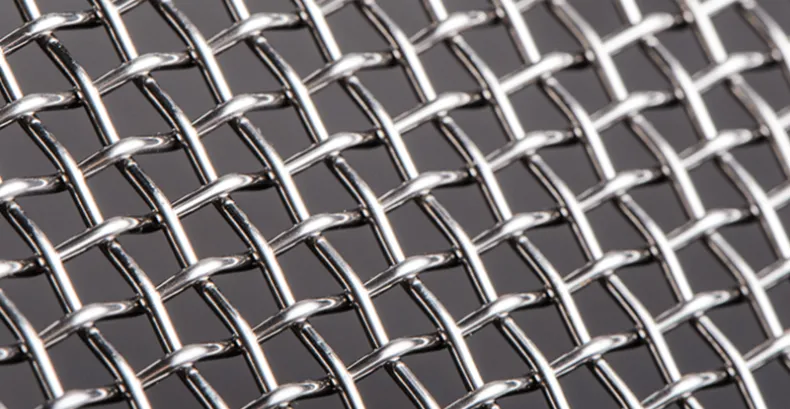
Plain weave is used mainly for small and medium apertures when consistent geometry is important. Single-crimp, double-crimp, and lock-crimp designs stabilize the wires at larger openings. Crimped sieves reduce wire movement at the intersections, although their stability depends on the relationship between wire diameter and aperture size, the crimp type, the support arrangement, and correct tensioning.
Galvanized wire sieves can reduce atmospheric corrosion during outdoor operation. In highly abrasive processes, however, the zinc coating gradually wears away, so galvanizing does not replace the need to select the proper base material. In quarries and recycling plants, support zones, tension bars, and areas of localized feed impact should also be inspected regularly.
The ranges shown in the table are indicative. The specific combination of aperture size and wire diameter should always be confirmed in the technical documentation, as not every combination is technologically available or operationally justified. An experienced sieve manufacturer takes into account not only aperture geometry but also the type of material, dynamic loads, and expected abrasive wear, which helps prevent premature failures and unnecessary production-line downtime.
|
Sieve type |
Aperture range |
Wire diameter |
Recommended application |
|---|---|---|---|
|
Single-crimp sieve |
2–40 mm |
0.8–6 mm |
Screening of fine and medium aggregates |
|
Double-crimp sieve |
4–100 mm |
2–10 mm |
Coarse aggregate, recycling, impact loads |
|
Lock-crimp sieve |
10–125 mm |
4–12 mm |
Large apertures and high node-stability requirements |
|
Plain weave |
0.04–4 mm |
0.03–2 mm |
Precision classification and process applications |
PN-EN ISO 9044 specifies requirements, permissible deviations, and inspection methods for industrial square-aperture wire cloth. It does not automatically cover all crimped sieves and welded panels. Pre-crimped surfaces and welded panels are subject to separate requirements and technical documents. Dimensional compliance alone does not guarantee screening quality, because the result also depends on screen settings and material properties.
The steel sieves used in industrial classification processes should be inspected regularly to ensure that aperture tolerances and wire condition remain compatible with the required product quality.
High-efficiency crimped sieves engineered for the toughest construction tasks
A construction sieve usually operates in a screening unit that is part of a crushing and classification line rather than directly “on the crusher.” The surface is subjected to cyclic loads from the vibrating drive, tensioning, and feed impacts. The lock-crimp weave limits relative wire movement at the intersections, but it does not eliminate the risk of deformation caused by overloading, improper installation, or material fatigue.
In dolomite and granite quarries, the service life of a construction sieve depends on particle size, feed rate, drop height, the number of decks, and the tensioning method. Without operational data, there is no basis for promising quarterly replacement intervals instead of replacement every few weeks. Properly selected steel sieves can, however, reduce the frequency of unplanned replacements and improve maintenance predictability.
Durable woven sieve ensuring clean separation and perfect mesh geometry
A woven sieve manufactured with a tight aperture tolerance improves the repeatability of fine-fraction separation, provided that feed conditions and material flow remain stable. A square aperture has the same nominal dimension in two perpendicular directions, but flat or elongated particles may pass depending on their orientation. Aperture geometry alone therefore does not provide complete control over product shape.
Screening efficiency depends simultaneously on open area, aperture uniformity, material bed thickness, deck inclination, vibration frequency and amplitude, and feed moisture. Even precise woven sieves therefore require proper adjustment of the entire process.
When particularly accurate separation is required, a properly tensioned woven sieve helps maintain a more uniform particle-size distribution and reduce batch-to-batch variability.

How a modern metal mesh for sieve systems effectively reduces costly downtime
Not every production stoppage is caused by an improperly selected screening surface. Failure of the drive, bearings, supporting structure, feed system, or incorrect operation can stop the line regardless of sieve quality. A properly selected metal mesh for sieve systems can, however, reduce the risk of premature deformation and wire breakage.
A properly selected metal sieve does not eliminate the need for technical inspections. It can, however, reduce the number of unplanned replacements and make service planning easier. It is also not appropriate to claim that the geometry will remain unchanged throughout an entire season. The condition of the apertures, wires, tensioning, and screened product should be checked at regular intervals.
Sieves metal meshes manufactured from material with insufficient strength may undergo permanent deformation, fatigue, or cracking. It is not possible to predict honestly that this will always occur after only a few weeks, because the wear rate depends on load, installation quality, and feed characteristics. Replacing a screening surface during a production changeover may generate losses greater than the price difference between material variants.
In agricultural processing plants, grain-cleaner meshes operate under different loading conditions than surfaces used in quarries. Strong impacts are usually less important, while aperture accuracy, surface cleanliness, and the reduction of grain damage become more critical. Dimensional control remains essential, but its level depends not only on the steel grade, but also on the weaving process, wire straightness, and the quality inspection of the finished surface.
Frequently asked questions about sieves metal meshes and screens
Selecting a screening surface requires consideration of feed type, required particle size, environmental conditions, and screen operating parameters. Below are answers to the most common questions regarding the design, materials, applications, and durability of industrial wire sieves. We also explain which parameters have the greatest impact on sorting accuracy and total operating cost.
How to choose the right braided steel sieves for your industry’s specifications
Selection begins with an analysis of the feed: hardness, moisture content, particle shape, the proportion of borderline fractions, and the required capacity. The recycling industry requires resistance to impact and pegging, while the food industry places greater emphasis on corrosion resistance, surface condition, and cleanability.
Braided steel sieves made from wire with a high elastic limit may withstand cyclic loads better than soft-wire constructions of the same diameter. For fine-grained materials, however, a “high weave density” is not enough. Aperture size, tolerance, wire diameter, and open area must be selected, and the result should then be verified under actual operating conditions.
What makes a wire sieve cross-weave stand out compared to standard options
The term wire sieve cross-weave is not a standardized construction name used in screening engineering. It most often appears as a search phrase related to crossword puzzles. It should not be used as the basis for inventing a separate weave type or claiming additional support points.
Technical documentation should use the actual design names: plain weave, single-crimp, double-crimp, or lock-crimp construction. If the phrase must be retained for SEO purposes, it should be explained in accordance with industry terminology, without attributing non-existent mechanical properties to it.
When to choose a metal sieve versus wire sieves of different designs
A metal sieve manufactured as a welded panel may be suitable where high rigidity and dimensional stability are the main priorities. This does not mean that every welded construction is suitable for the dynamic screening of heavy aggregates. Wire sieves with woven or crimped constructions are preferred when open area, elastic wire behavior, precise aperture dimensions, or compatibility with an existing tensioning system are important.
Modernization should not begin with the screening surface alone. Technical sieves, screen-drive parameters, deck design, feed arrangement, and the required capacity should be analyzed as one integrated system. Changing wire diameter or open area can affect both throughput and separation quality.
What determines the price and lifespan of professional steel sieves
The price depends on the steel grade, wire diameter, aperture type and size, panel area, manufacturing precision, edge preparation, and mounting components. It cannot be reduced to only a few variables, and the dimensions of the finished component must also be taken into account.
A more expensive material may reduce the total cost of ownership if it genuinely extends the interval between replacements or reduces production losses. However, there is no basis for a general promise of payback within one or two seasons. Such a period must be calculated from downtime duration, replacement cost, plant capacity, and actual operating data.
Service life also depends on installation quality. Uneven support, insufficient or excessive tension, loose clamping bars, and contact between the screening surface and the supporting structure can accelerate wire breakage. Without measurement data, it is not appropriate to claim that operating life will be reduced by exactly half.


